Apr 24 2008
The World’s Best Chef…
If you're new here, you may want to subscribe to my RSS feed so you don't miss any of the NEW IDEAS posted twice per day. Thanks for visiting!
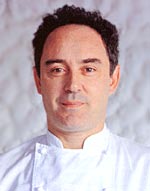
This week, the world’s top chefs and critics met in London for the S.Pellegrino World’s 50 Best Restaurants Award and, for the fourth time and third consecutive year, awarded the number one slot to El Bulli. It’s an amazing achievement by any standards but perhaps not much of a surprise. In the 21 years since Ferran Adrià became head chef at the restaurant in Roses on the Costa Brava, his rise to success has run parallel with the explosion in fine dining and the attendant phenomenon of gastro-tourism. In the past two decades, a golden age for the restaurant business, Adrià has become the single most significant player in the culinary world.
The story of Adrià’s rise is well documented. As a teenager he worked as a dishwasher in hotel kitchens and began learning traditional Spanish cuisine. At the age of 19, while drafted for military service, he became a cook and was quickly placed on the personal staff of a high-ranking officer.
At 22 he became a line cook at the already successful El Bulli restaurant, citing as his major motivation the desire to meet the girls who hung out at the nearby beach. Within 18 months he was head chef. The style of cooking Adrià pioneered, along with chefs such as Heston Blumenthal in the UK and Pierre Gagnaire in France, has been termed “molecular gastronomy” though Adrià himself doesn’t recognise the title. As he says: “People write that I began molecular cooking but if you ask them no one can define what it is.” Instead, he refers to his style, if pressed, as “avant garde” or “deconstructivist”.
El Bulli is studied by legions of fans and would-be diners around the world. It is closed for six months of each year while Adrià works on the next menu in his laboratory. The restaurant is permanently booked up and currently turns down three-quarters of a million requests for tables every year. At the moment, according to the foodie websites where such things are endlessly discussed, the best way to get a table is to book 10 days’ holiday in Barcelona, phone each morning to ensure you’re on the cancellations list, keep your mobile switched on and be prepared to drop everything. There are lists of other, merely brilliant, restaurants where you can console yourself while waiting for the call.
To add to the palpable sense of panic among the gastro-pilgrims, there is the persistent, tantalising rumour that he’s going to shut the whole place down. “We know about the rumours,” Adrià says, “and we’re not going to close El Bulli.” There is a deft pause before he continues: “But every single day we must face the challenge to reinvent the model through which we express ourselves. In the end, the important thing is what we say. Perhaps the model may change.
But his real coup has been much more significant is that he has become the figurehead of a global rebellion against the culinary power of France. Previously, brilliant young chefs all over the world were always testing themselves against classical French cuisine. Suddenly the world’s best food was not about 400 years of French tradition but ingredients, technique and creativity.
At the conclusion of his long acceptance speech at the awards last night, Adrià invited his compatriot Spanish chefs onto the stage at the Freemasons Hall in London to celebrate the fact that their country had more chefs in the top 10 than any other - even France. It’s no wonder chefs love Adrià. His personality validates them as artists, his stature puts reviewers and critics in their place, his technique opens new possibilities and his non-Frenchness gives chefs of every nationality an equal chance to succeed. Adrià has become a standard around which innovating chefs could cluster, giving restaurant cooking a new direction.
In a 2006 speech, he said: “One day people will come to my restaurant not for nourishment, but for an experience,” a statement that seemed to open a whole new territory, beyond food, into which creative chefs can expand. And creativity, never commercialism, is what, he says, drives him. “It is impossible to combine the goal of making money with making people happy with what we do,” he says. And yet nor does he care about making everybody happy. “In the end, what is important is what you have inside yourself, what you believe - not the opinion of 10 million.”
Because he’s Spanish, because of his creativity and his iconoclasm, Adrià is often placed in the tradition of Gaudí, Dali or Picasso. These might be useful comparisons but, like many creative people recognised in their own lifetimes, Adrià has also come to represent something more: his importance reaches far beyond the food he can create and the diners he can please by serving it.
As he held aloft his award on Monday night and gave his thanks and dedications, it seemed that, like a film star whose presence somehow transcends his performances, he has become an icon, representing how the whole of the “fine dining” world see themselves.
Yet with his creativity and cheerful disregard for convention he could at any moment turn his back on the whole of the industry, and it would only increase their regard for him. And might he? Could the most important chef in generations succeed in deconstructing himself out of running a restaurant?
“But, of course,” he answers, smiling, “El Bulli is not a restaurant. We don’t make any money. The books, the hotel, the other businesses, they make money. But it would not be possible to make money and continue to do what we do at El Bulli. We want to experiment, to please people, but we would never change something we do because of what people say. Is that a restaurant?”


Thanks for this article, Lindsay.
I learned of Adrià and El Bulli last September while dining with several chefs at a trade show exhibition. Fascinating discussion.
Just this past weekend there was a tour of El Bulli on the food network. The primary comment was how the food didn’t feel like you were actually “eating” because the texture it was like small bubbles and air… while retaining the full flavor of the described ingredients.
Regards
Nathan